CONF-CDS 2026

Blockchain and Fintech


Date

June 8th, 2025 (UTC+8)

Organizer

Beijing Computer Federation Blockchain and Digital Finance Specialized Committee

Symposium Chair

Prof. Wang Juan

Postdoctoral fellow at the University of Florida, and director of the Beijing Computer Federation

Personal Bio

Professor Wang Juan fulfills multiple roles in the Chinese digital tech-sector, including a reviewer of the Digital China and Web3.0 Innovation Competition, advisor to the Xiamen Free Trade Zone Digital Centre and Spark Chain Network, as well as an expert reviewer of blockchain projects for the Ministry of Industry, Information Technology, Civil Affairs, and the China Communications Standardization Association.

As the sole Chinese expert on the OECD Blockchain Policy Committee, Professor Wang is actively involved in critical projects. These notably include the OECD digital economic indicators and the ITU-T financial payment research. She also contributed substantially to the formulation of policy documents such as the "Implementation Plan for the National Digital Economy Innovation and Development Experimental Zone".

Apart from policy formulation, Professor Wang's academic contributions are remarkable, authoring a multitude of translated works. She has published more than 50 academic papers and is a regular invitee by leading media platforms for exclusive interpretations on policies related to digital economy and data transactions, among others. As a project leader, she has presided over nearly 30 high-profile projects in the fields of digital economy, fintech, blockchain, digital currency, data element market and cloud-based intelligence, earning her two national invention patents and a third prize of the Science and Technology Progress Award of the China Communications Society.

Symposium Committee Member

Lecturer, Xiaolong Li, Beijing University of Posts and Telecommunications, xiaolongli@bupt.edu.cn

Master, Kefei Liu, New York University, kl3295@nyu.edu

Senior Engineer, Qixiang Chen, Microsoft,gerhut@gmail.com

Master, Zhouming Zhang, Beijing University of Posts and Telecommunications, zhangzhouming@bupt.edu.cn

Master, Sijie Meng, Beijing University of Posts and Telecommunications, xiaolinlvzi@bupt.edu.cn

Call for Papers

Background

The Beijing Computer Federation presents the Blockchain and Fintech Workshop, an interdisciplinary gathering with a primary focus on Blockchain, Financial Technology, On-chain Storage Technologies, Non-Fungible Tokens (NFTs), Blockchain and Law, and Quantitative Trading. This forum is designed to encapsulate critical exchanges around technology and innovation by hosting contributory papers discussions, keynote addresses, and engaging panel dialogues, featuring distinguished guests including doctoral degree holders, master's degree holders, and industry experts as keynote speakers, while welcoming scholars and practitioners to participate in discussions and delve deeper into these cutting-edge domains.

Goal/Rationale

In an era defined by technological advancement, the Beijing Computer Federation proudly announces the Blockchain and Fintech Workshop. This event serves as a platform for scholars and enthusiasts to delve deep into the intricacies of blockchain, financial technology, on-chain storage technologies, non-fungible tokens (NFTs), blockchain and law, and quantitative trading. Our goal is to provide an engaging setting for distinguished guests including doctoral degree holders, master's degree holders, and industry experts to serve as keynote speakers, while welcoming young researchers, PhD candidates, scholars, and practitioners to collaborate, discuss, and learn about recent forays and developments in these fields. By promoting active dialogue and fostering innovation, we aspire to unlock and utilize the transformative potential that blockchain and fintech present. This Workshop offers an excellent opportunity to tackle challenges head-on and propel advancements in these fascinating areas of technology. Together, we aim to redefine digital horizons and contribute significantly to the evolving economic landscape.

Scope and Information for Participants

The Beijing Computer Federation invites you to contribute to our conference themed, "Blockchain and Fintech". We encourage discussions around:

  1. Integration of Blockchain Technology with Traditional Financial Services
  2. On-chain Storage Technologies and their Applications in Fintech
  3. Cross-modal Applications of Non-Fungible Tokens (NFTs)
  4. Legal Frameworks and Regulatory Aspects of Blockchain Technology
  5. Current Trends and Future Prospects of Quantitative Trading in the Fintech Industry

Through this conference, we aim to explore the harmonious merger of Blockchain in the existing financial ecosystem. We are looking forward to your thought-provoking inputs on how these technologies coexist and enhance each other to sculpt the future of the Fintech industry. This is a brilliant opportunity to share knowledge, ideas, and predictions, and to broaden our collective understanding.


Venue

12th Floor, Block B, Fukai Building, No. 19 Financial Street, Xicheng District, Beijing

Highlights


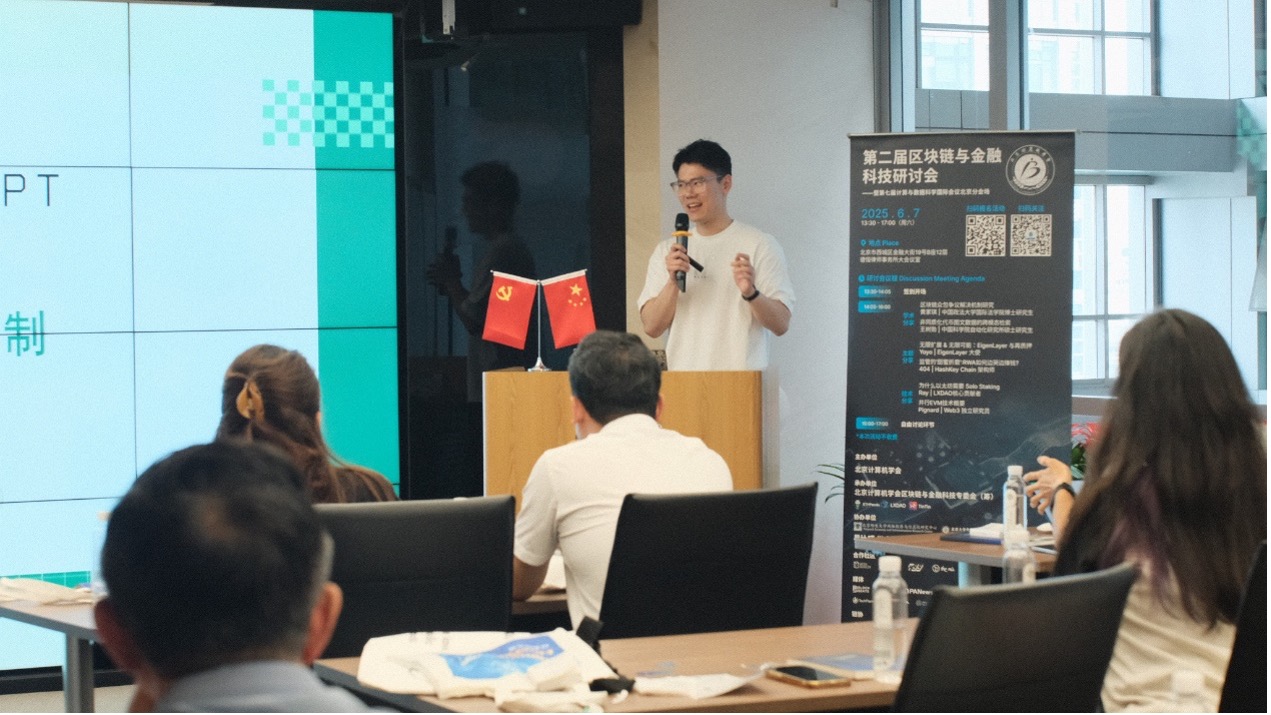
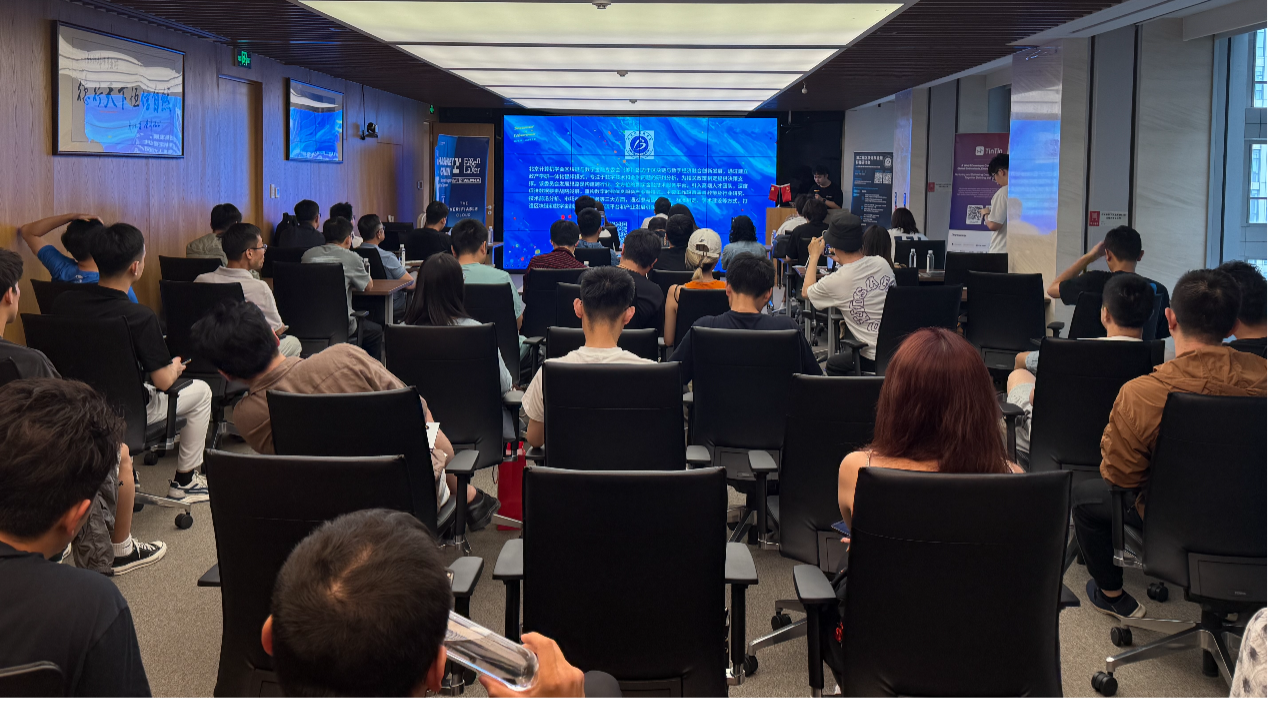
On June 7, 2025, the 2nd Workshop on Blockchain and Financial Technology — Beijing Symposium of the 8th International Conference on Computing and Data Science — was successfully convened.

This academic event was co-organized by the Beijing Computer Federation, with ETHPanda, LXDAO, and OurTinTinLand serving as the main organizers. It received additional support from Yidawi Academic Press, the Blockchain Association of Beijing University of Posts and Telecommunications, the Center for Network Emergency and Informatization Research at Peking University, and the Center for Market Economy Research at Peking University. The forum brought together experts and scholars from diverse fields including law, scientific research, software development, and infrastructure technology.

The symposium featured in-depth discussions on cutting-edge topics in blockchain technology. Jiaqi Huang presented a jurisprudential framework for resolving disputes arising from smart contracts. A system architect from HashKey Chain examined regulatory and compliance challenges related to real-world assets (RWA). An ambassador from EigenLayer introduced the modular security architecture of the restaking mechanism. Shuxun Wang, a graduate student at the Institute of Automation, Chinese Academy of Sciences, showcased AI applications for cross-modal retrieval of NFTs. A contributor from LXDAO discussed the significance of solo staking from the perspective of decentralization. Moreover, scalable solutions for parallel EVM (Ethereum Virtual Machine) architecture were also elaborated upon.

This symposium served as an important platform for advancing academic exchange and fostering deep integration among industry, academia, and research institutions. It contributed meaningfully to both theoretical innovation and practical application in the domains of blockchain and financial technology.

Image 1
Image 2
Image 3
Image 4
Image 5
Image 6

VISA


Visa for China

China Visa Information

  • Check which visa you need to get
    The majority of foreign citizens are required to obtain one of the China visas in order to visit the country, as there are only a few nationalities who are granted visa free entry for China for short stays. At the moment, travelers from countries who are not visa-exempt for China are obliged to apply for a visa in person from a Chinese embassy or consulate, with only a few exceptions, including for tour groups and airline crew from a few select countries. This is expected to change in the near future for select eligible nationalities when China introduces an electronic application form for visas. This will make it possible to apply for certain visa types for China exclusively online, eliminating the need to travel to an embassy or consulate in person.

    As the launch date for the Chinese electronic is yet to be finalized, however, non visa-exempt citizens are still currently required to apply for one of the following visa types for China from an embassy or consulate.

  • China Visa Registration Process
    Foreign nationals who wish to travel to China will need to follow a registration process to obtain their visa. The China Visa application form should be signed and every question must be answered. Applicants may select "none" if the question does not apply to their individual circumstances. Applications for the Chinese visa must be completed in block capital letters and handwritten changes will not be accepted. The signature on the China visa application must match the signature on the applicant's passport. People's Republic of China diplomatic missions require that each visa application is completed following strict guidelines. Supporting documents must be accurately and carefully prepared.

  • How Long Does It Take to Get a Visa to China
    Generally speaking, if the applicant meets all the requirements, has all the necessary documents and holds a passport with at least six months validity and two blank pages it should take about four working days to get a Chinese visa. Some People's Republic of China Diplomatic Missions offer rush service, which speed up the processing time of a visa for China. Nonetheless, it is only available for cases of extreme urgency and depend on the approval of the Chinese Consular Office. Foreign nationals who wish to travel to Mainland China, whether it is for tourism, business, transit or other, are recommended to apply between two months to fifteen days before their departure. If the traveler applies with too much time in advance, they visa might expire before they can use it. When a visa for China is granted, the validity period of such visa begins from the moment it was approved.

  • How Do You Get a Visa for China?
    The People's Republic of China has several types of visas in place. The visa a traveler needs depends on their citizenship, purpose of trip and the length of their stay. Currently, there are only some countries that are exempt from applying for a China visa to travel to Mainland China. However, the country does waive visas if the traveler meets specific requirements and is traveling to certain regions.
    To apply for a Chinese visa, the traveler will need to complete an application form, attach a recently-taken color photo, submit the application and pay the respective fee. Tourist that are from non-visa exempt countries should apply for the Tourist (L) visa, issued to aliens who are traveling to Mainland China for tourism purposes only. Those who wish to carry out business in China will need to obtain the Business (M) China visa.
    To successfully apply for a visa to China, the applicant will need to provide supporting documents and a valid passport. If applying for a Tourist (L) visa to China, the supporting documents refer to round-trip tickets, accommodation bookings, or an invitation letter from a travel agency in China. It is important to note that the China visa application requirements will vary depending on the type of visa the traveler is applying for.